
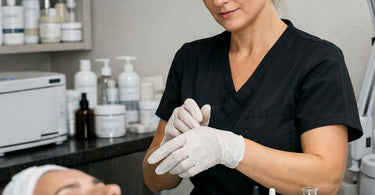
Because quality is non-negotiable... unless we are talking about the term "clean beauty," which apparently has all the legal definition of a unicorn. Let me paint you a picture bestie. It's a Tuesday afternoon, and your client is lying on your massage table, clutching a $24 smoothie, and she hits you with that look. You know the one. It is the "I did a deep dive on TikTok at 2 AM" look. She leans in, conspiratorially, and whispers, "You only use clean products, right? Like, no toxins?" You smile, nod, and internally scream just a little bit because you know that word—"clean"—is a slippery little eel. Is it science? Is it a vibe? Is it the ghost of a celery juice cleanse haunting your retail shelf? Today, honey, we are pulling back the curtain. We are going to spill the tea on why the $22 billion "clean beauty" industry is having a bit of an identity crisis, why your smartest clients are starting to side-eye the label, and how you—the educated pro—can navigate this mess without losing your mind or your professional credibility.
Let's be real. Over a third of beauty products on the shelf right now claim to be "clean," and that number is supposed to jump another 12% by 2027 [citation:4]. But here is the kicker: nearly half of the people buying those products have no idea what the label actually means [citation:4]. Cue the record scratch. We have an entire market segment built on a word that the FDA doesn't regulate. In the US, the term "clean" has no legal standing. None. Zero. Zilch. It means whatever a brand's marketing department had for breakfast that morning. For some, it means no parabens. For others, it means vegan. And for a few truly creative souls, it apparently means "our packaging looks good on an Instagram shelf." As a beauty pro, you are on the front lines of this confusion. You are the one who has to explain to a panicking bride why the "dirty" shampoo you are using is actually the only thing that will save her color. So grab a cup of coffee (or a glass of wine, no judgment), and let's dissect the chaos.
The Great "Free-From" Freak-Out: Why Your Clients Are Terrified of Chemistry
We have to talk about the fear factor. The clean beauty movement started with a beautiful, noble heart: ingredient transparency. We all want to know what we are putting on our bodies. The problem is that somewhere between the lab and the TikTok filter, "transparency" turned into "terror." Suddenly, every ingredient with a name longer than five letters became the enemy. But here is the science lesson nobody asked for but everybody needs: The dose makes the poison [citation:3]. Water is natural. Drink too much? Dead. Botulinum toxin is natural (hello, bacteria). It is also the active ingredient in... well, you know. It is a neurotoxin. Conversely, synthetic Vitamin C (ascorbic acid made in a lab) is chemically identical to the Vitamin C from an orange. It is often purer, more stable, and frankly, more effective. But because it was born in a lab, the "clean" police often label it suspicious. Make it make sense!
The reality is that chemistry is not the enemy. Chemistry is the language your skin speaks. When you slap on a moisturizer, the reaction that stops your transepidermal water loss? Chemistry. When you use a Hydrodermabrasion machine to exfoliate dead skin cells? Chemistry and physics doing the cha-cha. The current shift in the market proves this. According to recent data, the "clean" segment is slowing down, while brands backed by dermatologists, chemists, and clinical data are surging [citation:1]. Consumers are exhausted from trying to decipher fear-mongering marketing. They are moving from asking "Is this natural?" to asking "Does this work?" and "Prove it." This is your moment to shine as the expert who bridges that gap. You aren't afraid of a multi-syllable word. You know how to read an ingredient list for function, not just for hype.
The Preservative Paradox: Saving Skin from the Science Fair Project Gone Wrong
Okay, let's get into the weeds. The dirtiest little secret of the "clean" movement is the preservative paradox. Your clients demand products that are free of parabens or phenoxyethanol (often the safest, most studied preservatives available). But they also demand that their $68 cream doesn't grow fuzzy green mold after three days in a humid bathroom. You cannot have it both ways, darlings. Nature is full of bacteria, yeast, and mold. They love water. They love oils. They love to throw a party in a jar of "all-natural" goop.
When a brand refuses to use traditional, safe synthetic preservatives, they have two choices: a very short shelf life requiring refrigeration (inconvenient for a spa essential) or "natural" preservative systems. And here is the tea on those natural systems: they are often less thoroughly tested and can be significantly more allergenic. Essential oils are a common "natural" preservative booster. But essential oils are also a leading cause of contact dermatitis. I have seen more reactions from "clean" lavender oil and citrus extracts slathered on sensitized skin than I have ever seen from a regulated amount of paraben in a rinse-off product [citation:4]. So, what do we tell the client? We tell them the truth. A well-preserved product is a safe product. Those so-called "scary chemicals" are often the bodyguards standing between your client's pores and a raging staph infection. At Pure Spa Direct, we stock brands that prioritize stability and safety because using a professional cleaner on your tools isn't enough; the integrity of the cream in the jar matters just as much.
Natural vs. Synthetic: Slaying the Binary Dragon
The "clean beauty" movement loves a good villain. They need a dark lord to fight, and usually, they pick "Synthetic." But in the real world—the one where you have to wax a bikini line or perform a chemical peel—the line is blurry. Have you ever held a conversation with a poison ivy leaf? No, because you know it is "natural" and it will ruin your life. Meanwhile, lifesaving antibiotics are "synthetic" and they literally pull people back from the brink. The binary is a lie, and it is a marketing tactic designed to sell you fear.
We are seeing a massive pivot toward "clinical beauty" or "science-backed" skincare [citation:1]. This doesn't mean we are abandoning nature; it means we are being smarter about it. Biotechnology is the future. Imagine growing rare plant stem cells in a lab to create an active ingredient without harvesting acres of land or using tons of water. That ingredient is "lab-made," but it is also sustainable, potent, and pure. It is cruel to the planet to insist on wild-harvested ingredients when a lab-engineered version is identical and greener. As professionals, you need to educate your clients that "origin" does not equal "safety." A sunless tanning molecule doesn't care if it was born in a beaker or a beet; it just cares that it binds to the skin correctly without turning you orange.
How to Sell "Clean" Without Lying (Or Losing Your Soul)
So, how do you stock your shelves and run your waxing services without falling into the greenwashing trap? First, ditch the word "clean." It is useless. Replace it with specific language. Instead of saying, "We use clean products," say, "We avoid ingredient X because it triggers your client's specific sensitivity," or "We choose product Y because clinical trials show it hydrates 24% better." Specificity is the antidote to marketing fluff.
Secondly, look for third-party certifications that actually mean something. While the word "clean" is fluff, labels like Leaping Bunny (cruelty-free), EcoCert, or specific organic seals have legal teeth [citation:4]. They require audits. They require proof. They require the brand to walk the walk. When you are buying wholesale for your salon or spa, do your homework as the buyer. Look at brands like Tuel Skincare or Murad, which lean heavily into the science of skin health. They are not afraid to show you the data. Compare that to a brand whose entire website is just photos of leaves and the word "vibrant" repeated. You can feel the difference in professionalism instantly.
Tools of the Trade: What Actually Lives in Your Treatment Room
Let's bring it back to the tactile reality of your business. Whether you are doing a brow lamination or a full-body Salt Scrub, the efficacy of the product matters more than its origin story. You can't market your way out of a bad result. If you use a wax that doesn't grip the hair because the brand was too scared to use a proven adhesive agent (ironically, a synthetic often needed for grip), your client leaves stubbly. They don't care if it was organic; they care that you wasted their money.
This is why partnering with a distributor who understands the nuance is vital. At Pure Spa Direct, we carry the heavy hitters. Need a ItalWax that is hypoallergenic and low-temp but still rips like a champ? Got it. Need Lycon which uses specific synthetic polymers to grip coarse hair? Got that, too. We even carry the tools to make your hygiene speak for itself, like single-use spatulas for your Professional Wax Warmers. Hygiene is the ultimate "clean" sell. You could be using the crunchiest, granola-est wax on the planet, but if you double-dip that spatula, you are dirty. If you use a hard wax that allows you to avoid double-dipping entirely, you are a hero.
The Client Script: Answering the "Is This Toxic?" Question
You need a script, because when a client asks, "Is that chemical safe?" your eyes are going to roll back into your head instinctually. Stop that. Smile. Here is your line: "Great question! The word 'chemical' just means it is a substance. Water is a chemical. The safety is in the dosage and the research. We only choose products where the formula—the whole recipe—has been tested for safety and efficacy, not just the marketing story."
Or try this: "We focus on 'smart beauty' here. That means we look at the data. Sometimes, a lab-made ingredient is actually cleaner for the environment because it doesn't require heavy farming. We love natural ingredients when they work, but we won't sacrifice your results for a trend." See how powerful that is? You positioned yourself as the educated gatekeeper. You didn't bash "clean" products, but you elevated the conversation above a TikTok scare video. You sound like a clinician, not a salesperson.
Curating Your Inventory: What to Look For Right Now
The future of the industry is not "clean" vs. "dirty." It is transparency. It is the brands that list their ingredients and explain *why* each one is there. It is the brands that don't hide behind "fragrance" (a notorious catch-all term for trade secrets) but tell you what makes that rose smell like roses. We are seeing a rise in what Mintel calls the "push-pull between nature and science" [citation:8]. Clients want the romance of a botanical garden but the results of a medical clinic. You can give them both.
Stock your shelves with the bridges. Look at the Avry Beauty line for treatments that feel luxurious but are ethically made. Check out the biotechnology-derived ingredients that are saving the planet one petri dish at a time. And for the love of all that is holy, train your staff on the difference. If your esthetician tells a client that "parabens are poison," that is a liability. It is untrue and it makes the rest of your professional-grade products look suspect. Train them on *function*: "We use this preservative system because it is broad-spectrum and gentle, ensuring the product stays stable for you."
The Bottom Line (And a Little Tough Love)
Look, the "Clean Beauty" movement did us all a favor by forcing ingredient lists into the spotlight. For that, we say thank you. But the movement grew up, went to college, and is now having an existential crisis. The truth is that marketing is driven by emotion, but science is driven by data. If you run a business based on the emotion of the month, you are going to be swapping out your entire product line every six months when the next scare comes along. Is it "sulfates" this month? Is it "silicones"? (Spoiler: Silicones are actually great for smoothing the hair cuticle and preventing friction, but try telling that to the girl who just watched a video of someone frying an egg in dimethicone).
Anchor your business in results. Anchor it in safety. Anchor it in the undeniable fact that you are a professional who has access to wholesale pricing on the best equipment in the world, from Facial Steamers to Professional Shears. You have better things to do than panic over a well-formulated lotion. So, next time a client asks if you are "clean," tell her, "No, darling, I am not clean. I am effective. And I have the clinical results to prove it." Then hand her a tissue, flip on your Magnifying Light, and show her exactly how beautiful her skin looks when science does the heavy lifting.
)